A good outdoor space in Kerala has to survive more than admiration.
It has to take rain that comes hard and sideways. It has to take heat that sits on the surface by noon. It has to take moss, red soil, children running barefoot, scooters parked where they should not be parked, coconut fronds falling, wet footwear, garden water, ants, roots, and the slow laziness that enters maintenance after the first six months.
That is where natural stone starts to prove itself.
Not on the first day, when everything looks clean and new. Any material can look good on the first day. Concrete pavers, ceramic outdoor tiles, stamped surfaces, and even cheap cladding panels can impress in a fresh photo. The real test comes after two monsoons. The joints open. The color fades unevenly. The surface becomes slippery near the tap. The edge near the driveway chips. The owner starts asking why the garden looks tired so quickly.
Natural stone does not solve every problem. Badly laid stone will still fail. Poor drainage will still ruin the best material. A polished surface in the wrong place can become dangerous. Thin stone fixed over weak concrete can crack. No material forgives careless work forever.
Still, when the site is understood properly, Natural Stone Landscaping, Kollam, Kerala, gives a kind of strength and age that manufactured materials struggle to match.
Kerala houses have a special problem with outdoor design. The building may be modern, but the land around it is still tropical. Heavy rain, high humidity, tree shade, laterite soil, hard sun, salt air near coastal areas, and narrow compound spaces all sit together. A landscape cannot be copied from a Dubai villa, a Bengaluru gated community, or a Pinterest garden from Europe. It has to belong here.
Stone belongs here more naturally than most materials.
Natural Stone Is Practical Before It Is Decorative
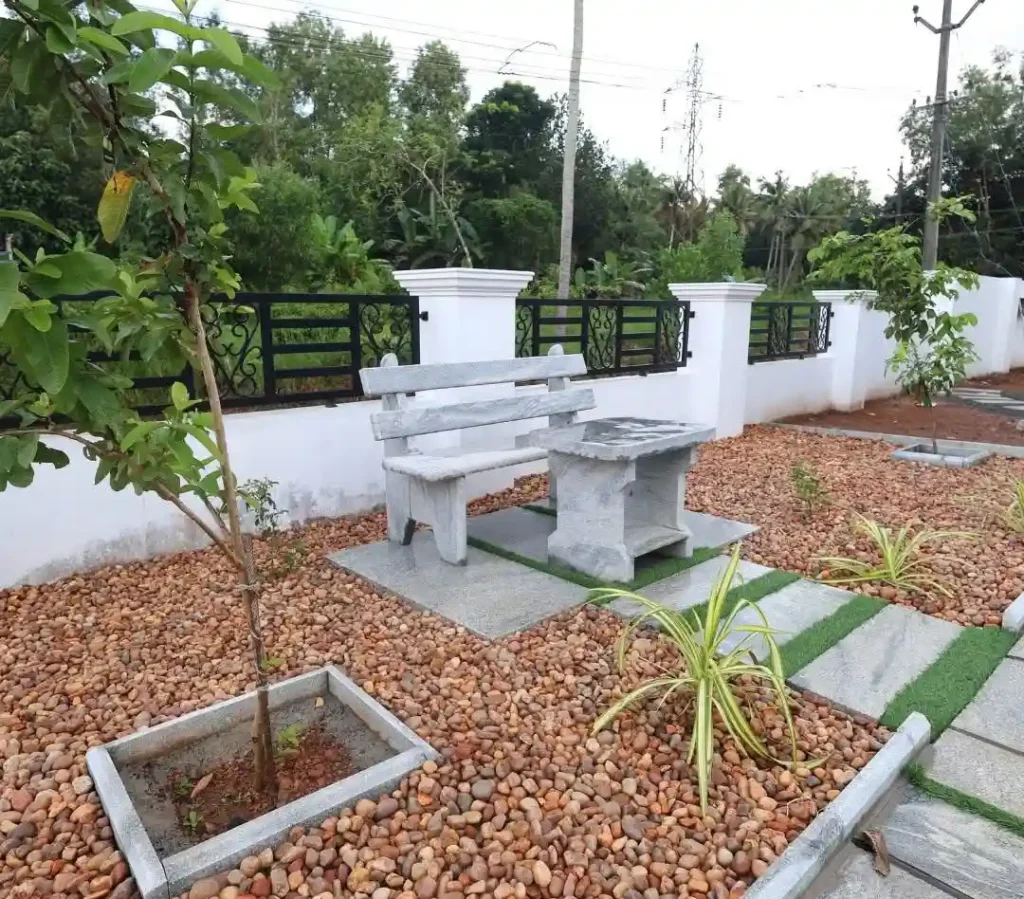
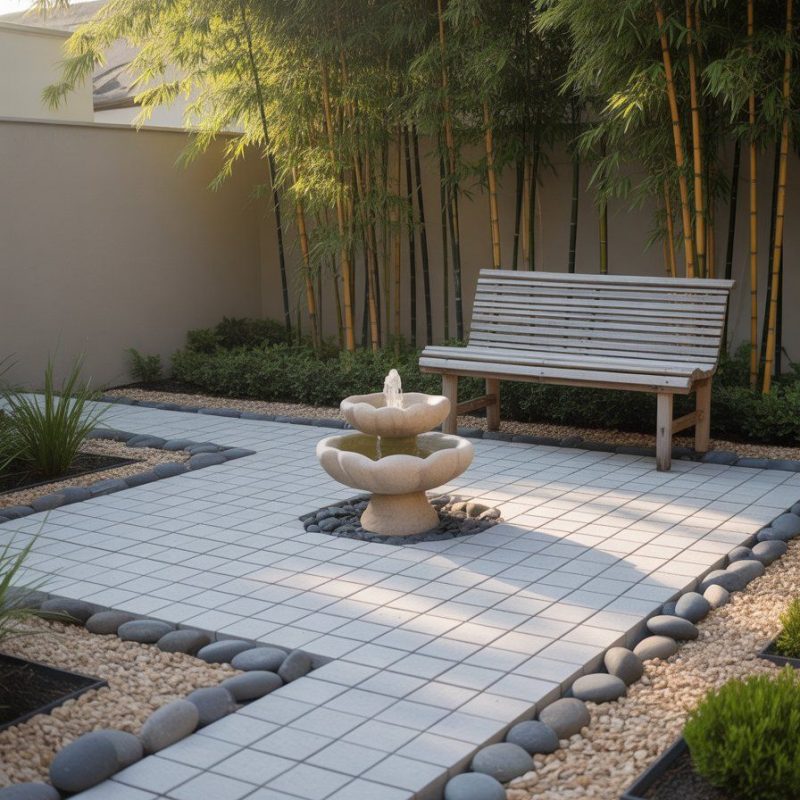
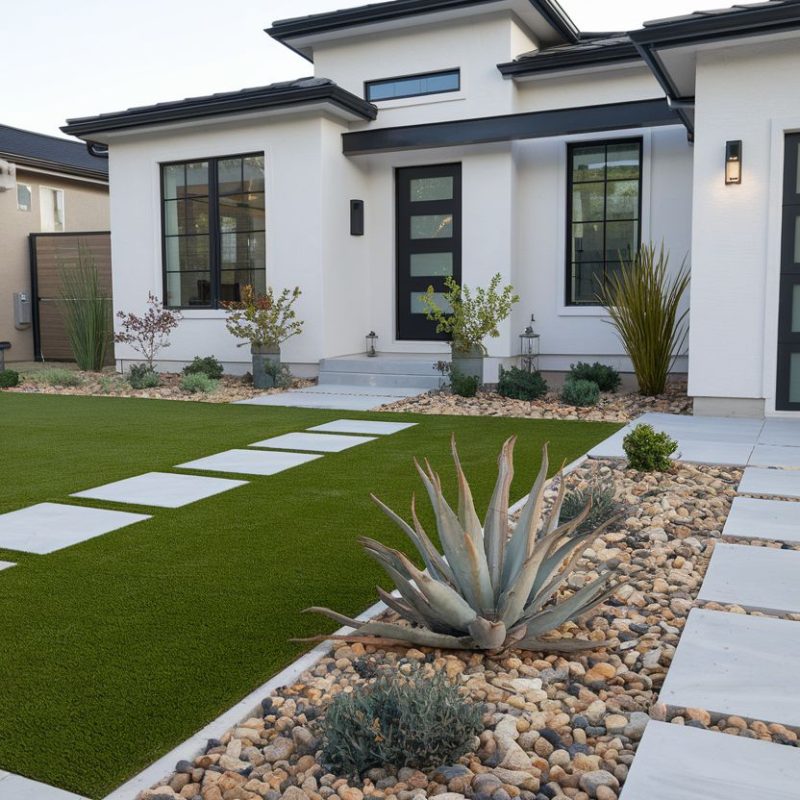
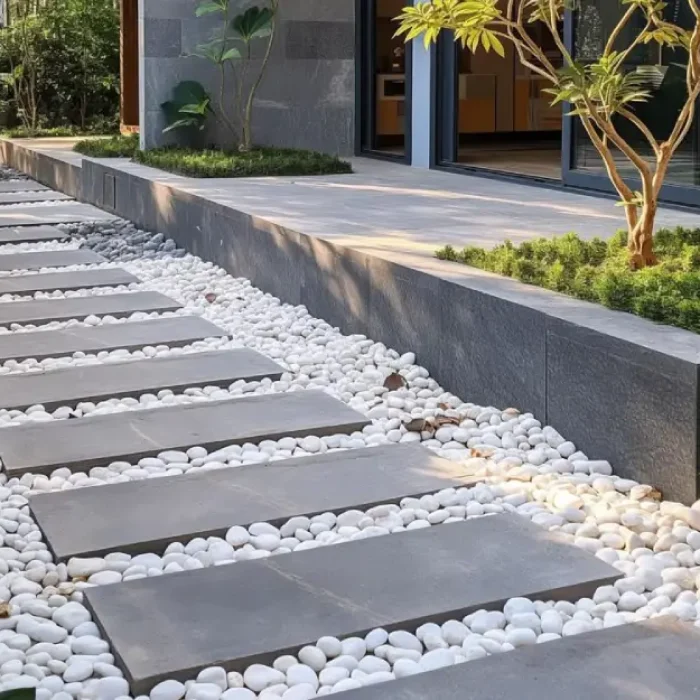
Granite steps near the entrance, rough-cut pathways through a garden, laterite retaining edges, cobbled strips near a driveway, stone seating under shade, water channels lined properly, natural stone wall cladding on a compound wall — these are not decorative tricks. They are practical choices when done with proportion and restraint.
The mistake is thinking of stone only as a luxury finish.
Some of the best stonework is quiet. A narrow path that stays firm during rain. A step that does not move under the foot. A garden border that does not break when soil swells. A courtyard surface that looks better after use instead of worse. A drain cover line that blends instead of shouting. These things do not always attract attention, but they prevent daily irritation.
There is a fashion now for clean outdoor tiles. Large format. Smooth. Beige or grey. They look neat in showroom lighting. On a Kerala site, especially near a garden or wash area, I am careful with them. If the surface has no grip, the first monsoon exposes the mistake. The cleaner the tile looks, the more every stain shows. Once water enters through weak joints, hollow sounds begin. Then cracks. Then patch repair.
Stone is not automatically safer, but the right stone finish is usually more forgiving. Flamed granite, rough Tandur, bush-hammered surfaces, natural cleft stones, and properly textured slabs — these give the foot something to hold. That matters more than a glossy brochure finish.
A landscape is not only for looking at.
It is for walking after rain with wet slippers. For washing the car. For placing a chair in the evening. For children cycling in circles. For elderly parents going to the gate slowly. For guests entering without slipping. For staff cleaning without damaging edges. Beauty that ignores these uses becomes a nuisance.
I disagree with the common advice that “any outdoor tile is fine if it is anti-skid.” That word gets used too casually. “Anti-skid” in a catalog does not always mean safe in a shaded, wet, moss-prone Kerala courtyard. The surface texture, slope, drainage, cleaning habit, and exposure to sun all matter. A shaded north-side path is different from an open terrace edge. A stone near a pond is different from a driveway strip.
Natural Stone Landscaping, Kollam, Kerala, needs that kind of judgement.
Choosing the Right Stone for the Right Place
Granite is usually the safe worker. Strong, available, hard, and familiar to local labour. For driveways, entrance steps, edging, and heavy-use areas, it performs well when the thickness is right and the base is prepared. But granite can look too harsh if the whole space is covered with it. A garden should not feel like a railway platform. Texture and placement decide whether granite feels elegant or severe.
Laterite has a different character. It feels Kerala without trying. Warm, earthy, soft-looking, and connected to old compounds and traditional houses. It works beautifully in walls, edging, raised beds, and rustic features. But laterite is not for every wet walking surface. It can weather, shed, and absorb water depending on quality. Good detailing matters. Use it where its ageing becomes part of the look, not where constant abrasion will punish it.
Sandstone can be beautiful in garden paths and sitting areas, especially when the colour is chosen carefully. It gives a softer mood than granite. The issue is porosity and surface wear. In very wet, shaded places, some sandstone needs more care. Sealing may help, but sealing is not magic. If the stone is poor quality or laid badly, the problem will return.
Slate has texture and mood. It suits feature walls, garden corners, and certain pathway designs. Some types can flake when exposed badly, so selection matters. A sample piece should not decide the whole project. A stone may look fine in hand and behave differently in a large outdoor surface.
Kota and Kadappa are common names in South Indian work. They can be useful, but the finish and application must be chosen honestly. Smooth dark stone near wet areas can become slippery. Light coloured stones may show stains. A surface that works in a covered verandah may not work in an open garden path.
Cobblestones are good for driveways when laid on a proper base with tight workmanship. Bad cobble work is painful. Uneven levels, loose joints, weak edges, water standing between stones — all these turn a strong material into a daily annoyance. A cobbled driveway should have proper compaction below, edge restraint, slope, and joint filling. Without that, the vehicle load will slowly expose every shortcut.
People often ask for a low-maintenance landscape. Usually they mean no maintenance.
That does not exist in Kerala.
Leaves fall. Moss grows. Soil moves. Rain carries dirt. Roots push. Even the best stone needs cleaning, joint checking, and occasional attention. The advantage is that natural stone usually accepts maintenance better than artificial surfaces. It can be cleaned, reset, repaired in patches, and allowed to age. A faded concrete paver often looks tired. A weathered stone can look settled.
There is a difference.
Drainage, Base Work, and Site Judgement Matter Most
For a home in Kollam, the choice of stone should start with how the place is actually used. Not with colour. Not with Instagram references. Start with movement. Where does water flow? Where does the car turn? Where do people enter during rain? Where does the house help wash vessels or garden tools? Which side stays shaded? Where does algae already form? Which area gets salt air? Where are the roots likely to travel?
Only after that should design begin.
A landscaper in Kollam, Kerala, who ignores drainage and talks only about pattern is not solving the site. Patterns are easy. Herringbone, random rubble, linear strips, stepping stones, mosaic-style pieces — all can be drawn. The hard part is making sure the chosen stone does not become loose, slippery, stained, or awkward to clean.
The base below the stone is where money is often wasted or saved.
A client sees the top surface. The worker knows what went under it. Weak base preparation is the silent reason for many failures. If the ground is not compacted, if the bedding layer is uneven, if the slope is guessed by eye, if water is allowed to sit below stone, the surface will move. Once movement starts, joints break. Once joints break, water enters. Then the owner blames the stone.
Sometimes the stone was never the problem.
Kerala rain is unforgiving. Water should be guided, not fought. A natural stone courtyard needs slope, but the slope should not feel like a ramp. A pathway needs drainage, but the drain should not cut the design into ugly pieces. Around lawns and planting beds, levels must be handled carefully because soil will wash onto stone. Near outdoor taps, the surface must be stronger and easier to clean. Near a gate, tyre load changes the specification.
These are small decisions. They decide whether the landscape grows old well.
The beauty of stone is not only in colour. It is in shadow. A rough edge catches light differently in the evening. A natural surface makes planting look less artificial. Stone steps near a green patch feel calmer than tiled steps. Even a simple pathway with irregular slabs can soften a new building that otherwise looks too sharp.
This is why Natural Stone Landscaping Kollam, Kerala has become more relevant, not less, even with so many modern materials available.
There is also the question of value. Not the exaggerated claim that landscaping will automatically raise property price by some fixed percentage. Property value is not that simple. Location, road access, building condition, parking, water, documentation, neighbourhood, and market timing all matter.
But a well-built outdoor space changes how a property is judged.
A house with a clean entrance, safe steps, proper driveway, shaded seating, organised planting, and durable stone surfaces feels cared for. Buyers and visitors sense it before they analyse it. Commercial properties feel more established when the exterior does not look temporary. Resorts, clinics, offices, homestays, apartment entrances — stone gives weight when the detailing is disciplined.
A Leading Landscaping Company in Kollam, Kerala should be able to say no to the wrong stone. That matters. If the client wants glossy black stone in a wet outdoor entrance, someone should stop it. If the budget cannot support proper base work, the design should be simplified instead of pretending everything is possible. If maintenance will be poor, the material should be chosen for forgiveness, not delicacy.
Good landscape work is not about saying yes to every idea.

Let Natural Stone Age Honestly Outdoors
Stone also has a supply side that people rarely discuss. Size variation, thickness tolerance, edge quality, colour consistency, and transport damage all affect the final result. Two batches of the same stone may not match perfectly. Natural variation is part of the charm, but uncontrolled variation can look messy. Before ordering, the site team should know whether the design accepts variation or needs tighter selection.
When choosing Stone Products in Kollam, Kerala, do not judge from a wet sample alone. Wet stone looks richer. Dry stone may look duller. A showroom sample may be sealed, cleaned, or freshly cut. Ask to see dry pieces. Ask how the stone behaves outdoors. Ask about thickness. Ask whether it is suitable for vehicle movement, walking, wall cladding, or only decorative use.
A garden path does not need the same stone as a driveway. A wall face does not need the same finish as a step. A courtyard under full sun behaves differently from a shaded side passage. Matching everything can make a landscape flat. Mixing too many stones can make it restless. The better work usually sits between those two mistakes.
Use stone like a language, not like a catalogue.
There are places where natural stone may fail to satisfy the client. Someone who wants a perfectly uniform, spotless, factory-made look may not enjoy stone ageing. Someone who dislikes colour variation may become irritated by natural material. A family that never cleans wet shaded areas may still get moss. A property with poor drainage from the building side may damage any surface. A very low budget with high expectations can lead to thin stone, poor labour, and disappointment.
No material should be sold as trouble-free.
The best results come when the owner accepts the nature of stone. It will age. It will take marks. Some edges may soften. Colour may deepen in wet areas. Tiny variations will remain visible. That is not failure. That is the material living outdoors.
Concrete often looks best when new. Natural stone often looks better when it settles.
This is not romantic talk. It is practical. Kerala landscapes need materials that do not panic when the weather changes. Stone has already spent a long time becoming itself before it reaches the site. When cut, laid, and detailed properly, it can handle years of use with dignity.
Natural Stone Landscaping Kollam, Kerala works best when design is kept honest. Do not cover every inch just because stone is strong. Leave planting space. Respect water flow. Keep walking lines clear. Use rougher finishes where people step. Use heavier stone where vehicles move. Avoid sharp level changes that elderly people may miss. Keep edges visible at night. Think about cleaning access. Think about the person who has to sweep the leaves every morning.
A beautiful outdoor space should not punish the people who maintain it.
The future of landscaping in Kerala will probably keep mixing modern architecture with older material sense. Clean houses, large windows, simple walls, tropical planting, stone paths, shaded courts, water features used carefully, and fewer fake decorative pieces. That is a better direction than filling the compound with shiny tiles and plastic-looking garden features.
Stone gives the landscape a base. Plants bring change. Light brings mood. Water brings movement. The house gets a setting instead of sitting naked on a plot.
That is the real reason natural stone remains the better choice for many outdoor spaces. It does not try too hard. It lasts when respected. It carries local character without looking old-fashioned. It can be rough, refined, traditional, or modern depending on the hand that uses it.